
 Tweet
Tweet
 Terror in Spain
This is truely bad newz::
Thursday, March 11, 2004 Posted: 2:00 PM EST (1900 GMT)
MADRID, Spain (CNN) -- A series of co-ordinated bomb attacks on Madrid's commuter train system killed at least 190 people and wounded more than 1,200 at the height of the city's rush hour, the Interior Ministry said.
Spanish officials are blaming terrorists from the Basque separatist group ETA -- designated a terror group by the United States and the European Union -- for the attack.
But so far, there has been no claim of responsibility.
The Spanish ambassador to the United States, Javier Ruperez, believes ETA was responsible and said "in a way it is" Spain's September 11, referring to the U.S. terror attacks in 2001.
"We have been fighting against terrorism for the last 35 years. I know what terrorism is. I was kidnapped in 1979 by the same people," Ruperez said.
"We've been fighting against that scourge for quite a number of years. But, certainly, this is the first time we have that massive experience of being killed."
Before Thursday's attack, the highest death toll in any ETA-linked attack was in 1987 -- when 21 were killed in a Barcelona supermarket blast.
Attacks blamed on or claimed by ETA through the years have killed 800 people in Spain.
Prime Minister Jose Maria Aznar addressed the nation and condemned the terrorists attack, saying ETA must be crushed, and opposed negotiations with them.
"There is no possible negotiation with these killers," he said.
An official from Spain's northern Basque region called it the worst terrorist attack in Spanish history.
Countries across the world expressed their outrage. (Global reaction)
U.S. President George W. Bush sent his condolences to Spain, one of the top U.S. allies in the Iraqi war, saying "we weep with the families" and "we stand strong with the people of Spain."
British Foreign Secretary Jack Straw called it "a disgusting assault on the very principle of European democracy."
The U.N. Security Council unanimously passed a resolution condemning the bombings, but did not cast blame on any group.
The attacks took place at the height of Thursday's rush hour when three separate trains were hit by near-simultaneous explosions before 8 a.m. (2 a.m. ET) along the southern part of Madrid's train network, officials said.
Interior Minister Angel Acebes said there were a total of 10 explosions at the Santa Eugenia, El Pozo and Atocha stations, and three other bombs found and detonated by police.
The most deadly blast happened on a train entering Madrid's main Atocha station, according to Acebes.
Security forces found other bombs, and detonated them in controlled explosions, he added.
Survivors described scenes of chaos and panic in the Spanish capital.
"The worst was people screaming for help inside the train and there was nothing we could do," one survivor told CNN's Spanish sister network, CNN+.
People in tears walked away from the city's main Atocha station in droves as rescue workers carried bodies away from the scene.
Many people with bloodied faces sat on curbs, using mobile phones to tell loved ones they were alive. (More eyewitness)
The attack comes ahead of Sunday's general election in which Spain's conservative ruling Popular Party -- which has taken a hard-line stance against ETA -- is currently leading in the polls.
After the blasts, all political parties announced they were suspending campaign rallies ahead of Sunday's election, but there has been no word that elections would be suspended.
The government called for a three-day period of mourning and impromptu anti-ETA demonstrations have broken out in Madrid and other Spanish cities.
Demonstrators hold up their hands, calling for an end to violence, at a gathering in Seville.
Spanish police -- who have foiled several recent bombing attempts by ETA -- were on high alert for terror attacks by the separatist group ahead of Sunday's vote. (On The Scene)
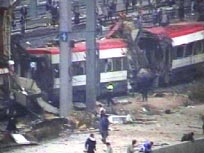
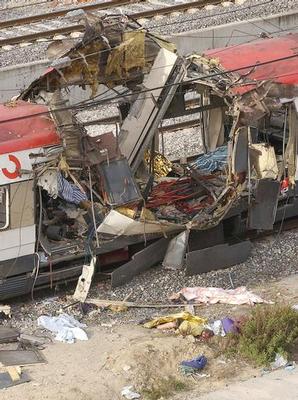
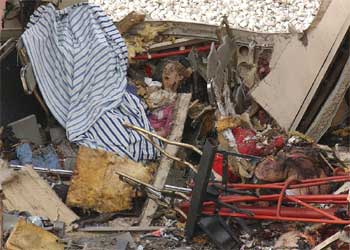
Video of the scene showed the train at Atocha broken into pieces by the force of the explosions.
Medical staff set up a field hospital to treat the wounded at the scene, and buses were mobilized to help ambulances transport the wounded to hospitals.
Shortly after the blasts, Basque leader Juan Jose Ibarretxe held a news conference from the Basque capital of Vitoria, condemning the violence and calling for demonstrations against ETA.
Basque member of Parliament Gustavo Aristegui -- who was in Madrid at the time of the attack -- also blamed ETA for the attack.
"This is probably Spain's worst terrorist attack in history -- not probably, surely our worst terrorist attack ever," Aristegui told CNN. "There are people that are real monsters that are trying to blackmail the whole society through acts of terror."
In an interview on Radio Popular in the Basque country, Arnaldo Otegi, leader of banned radical political party Batasuna, said he did not believe ETA was responsible for the attacks.
The attacks, he said, could have been "an operation by sectors of the Arab resistance."
Citizens queue up to donate blood in Madrid.
But Acebes said Otegi was simply trying to confuse the situation.
ETA has been fighting for an independent homeland in northern Spain.
Spanish Foreign Minister Ana Palacio placed the blame squarely on ETA, saying "we knew they are preparing a very big terror attack."
"ETA has a very clear pattern in its activities and we unfortunately have a long experience in dealing with them," she said.
On February 29, Spanish police seized more than 1,000 pounds of explosives and arrested two suspected ETA members who were planning to carry out an imminent attack in Madrid, an official said. (Full story)
CNN Madrid Bureau Chief Al Goodman contributed to this report.

Thursday, March 11, 2004 Posted: 2:00 PM EST (1900 GMT)
MADRID, Spain (CNN) -- A series of co-ordinated bomb attacks on Madrid's commuter train system killed at least 190 people and wounded more than 1,200 at the height of the city's rush hour, the Interior Ministry said.
Spanish officials are blaming terrorists from the Basque separatist group ETA -- designated a terror group by the United States and the European Union -- for the attack.
But so far, there has been no claim of responsibility.
The Spanish ambassador to the United States, Javier Ruperez, believes ETA was responsible and said "in a way it is" Spain's September 11, referring to the U.S. terror attacks in 2001.
"We have been fighting against terrorism for the last 35 years. I know what terrorism is. I was kidnapped in 1979 by the same people," Ruperez said.
"We've been fighting against that scourge for quite a number of years. But, certainly, this is the first time we have that massive experience of being killed."
Before Thursday's attack, the highest death toll in any ETA-linked attack was in 1987 -- when 21 were killed in a Barcelona supermarket blast.
Attacks blamed on or claimed by ETA through the years have killed 800 people in Spain.
Prime Minister Jose Maria Aznar addressed the nation and condemned the terrorists attack, saying ETA must be crushed, and opposed negotiations with them.
"There is no possible negotiation with these killers," he said.
An official from Spain's northern Basque region called it the worst terrorist attack in Spanish history.
Countries across the world expressed their outrage. (Global reaction)
U.S. President George W. Bush sent his condolences to Spain, one of the top U.S. allies in the Iraqi war, saying "we weep with the families" and "we stand strong with the people of Spain."
British Foreign Secretary Jack Straw called it "a disgusting assault on the very principle of European democracy."
The U.N. Security Council unanimously passed a resolution condemning the bombings, but did not cast blame on any group.
The attacks took place at the height of Thursday's rush hour when three separate trains were hit by near-simultaneous explosions before 8 a.m. (2 a.m. ET) along the southern part of Madrid's train network, officials said.
Interior Minister Angel Acebes said there were a total of 10 explosions at the Santa Eugenia, El Pozo and Atocha stations, and three other bombs found and detonated by police.
The most deadly blast happened on a train entering Madrid's main Atocha station, according to Acebes.
Security forces found other bombs, and detonated them in controlled explosions, he added.
Survivors described scenes of chaos and panic in the Spanish capital.
"The worst was people screaming for help inside the train and there was nothing we could do," one survivor told CNN's Spanish sister network, CNN+.
People in tears walked away from the city's main Atocha station in droves as rescue workers carried bodies away from the scene.
Many people with bloodied faces sat on curbs, using mobile phones to tell loved ones they were alive. (More eyewitness)
The attack comes ahead of Sunday's general election in which Spain's conservative ruling Popular Party -- which has taken a hard-line stance against ETA -- is currently leading in the polls.
After the blasts, all political parties announced they were suspending campaign rallies ahead of Sunday's election, but there has been no word that elections would be suspended.
The government called for a three-day period of mourning and impromptu anti-ETA demonstrations have broken out in Madrid and other Spanish cities.
Demonstrators hold up their hands, calling for an end to violence, at a gathering in Seville.
Spanish police -- who have foiled several recent bombing attempts by ETA -- were on high alert for terror attacks by the separatist group ahead of Sunday's vote. (On The Scene)
Video of the scene showed the train at Atocha broken into pieces by the force of the explosions.
Medical staff set up a field hospital to treat the wounded at the scene, and buses were mobilized to help ambulances transport the wounded to hospitals.
Shortly after the blasts, Basque leader Juan Jose Ibarretxe held a news conference from the Basque capital of Vitoria, condemning the violence and calling for demonstrations against ETA.
Basque member of Parliament Gustavo Aristegui -- who was in Madrid at the time of the attack -- also blamed ETA for the attack.
"This is probably Spain's worst terrorist attack in history -- not probably, surely our worst terrorist attack ever," Aristegui told CNN. "There are people that are real monsters that are trying to blackmail the whole society through acts of terror."
In an interview on Radio Popular in the Basque country, Arnaldo Otegi, leader of banned radical political party Batasuna, said he did not believe ETA was responsible for the attacks.
The attacks, he said, could have been "an operation by sectors of the Arab resistance."
Citizens queue up to donate blood in Madrid.
But Acebes said Otegi was simply trying to confuse the situation.
ETA has been fighting for an independent homeland in northern Spain.
Spanish Foreign Minister Ana Palacio placed the blame squarely on ETA, saying "we knew they are preparing a very big terror attack."
"ETA has a very clear pattern in its activities and we unfortunately have a long experience in dealing with them," she said.
On February 29, Spanish police seized more than 1,000 pounds of explosives and arrested two suspected ETA members who were planning to carry out an imminent attack in Madrid, an official said. (Full story)
CNN Madrid Bureau Chief Al Goodman contributed to this report.
![[Coi] Mr.CLuBBeR](./core/images/default/default_avatar_medium.png "[Coi] Mr.CLuBBeR")


Comment